This is my final presentation video that discusses each of my posts throughout the semester and dives into multiple ways of seeing. I really enjoyed creating, analyzing and giving my own input on these modes of media and communication. Thanks for listening!
MEME
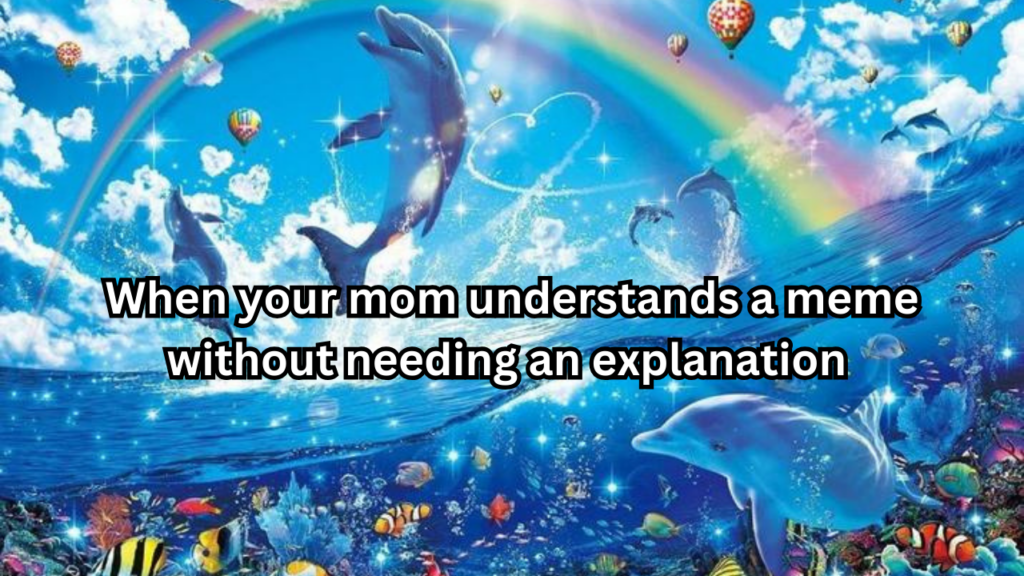
I chose the dolphin meme because it has become a popular trend on TikTok, often accompanied by the song “Symphony” and paired with humorous captions. This specific meme format works both with and without the background music, making it a versatile example of internet culture. This meme’s trend on TikTok is a good example of how memes can evolve and adapt, taking on new meanings depending on the context in which they are shared. The dolphin image in particular, when paired with the right text, creates an absurd but relatable moment that speaks to the power of internet humor. My intended message with this meme is to comment on how meme culture is very generational, with certain memes being more understandable to younger audiences who are more immersed in social media trends. The meme illustrates how some humor and references may not translate well across different age groups or generations, making memes a form of communication that is often not universal.
I chose this meme and text, “When your mom understands a meme without needing an explanation,” to highlight the surprising moment when something that was once an exclusive part of younger internet culture becomes understood by older generations, in this case, parents. This unexpected understanding of memes by an older generation is be both humorous and relatable because it reflects the expansion of the current meme culture. The image of the dolphin represents the exaggerated emotional reaction that young people might feel when their parents grasp something that is often seen as “theirs” in the digital world. This choice makes the meme a meta-meme because it comments on how memes themselves have become a generationally-encoded form of communication. The meme reflects on how certain memes are tied to specific age groups and communities, and the humor in the text comments on the divide and occasional overlap in how memes are understood. By using a format that’s familiar to younger social media users, I’m pointing out the way memes have become a way of expressing generational identity and communicating shared experiences online, making it both a reflection on meme culture and a product of it.
VIDEO
In this video assignment, I decided to use CapCut instead of Descript to edit and record my media. I chose to do this because I was much more familiar with editing video and audio on this platform. This choice helped me a lot when editing the video because I was easily able to cut the audio the way I wanted and I could play around with some cool visual features like transitions and animation. In terms of the content I chose, I knew I wanted to use an apple commercial in the context of the Bruner reading because they do such a great job of telling a story while showing off their products.
AUDIO
The Power of Writing
In this audio, I explore Walter Ong’s insightful talk from 1977, where he discusses the impact of writing on human thought and communication. Ong contrasts oral and written cultures, revealing how this shift not only transforms our understanding of knowledge but also reshapes the way we perceive and interact with the world around us. Join in as we unpack his arguments and their relevance in today’s digital world.
IMAGE
All photographs are memento mori. To take a photograph is to participate in another person’s (or thing’s) mortality, vulnerability, mutability. Precisely by slicing out this moment and freezing it, all photographs testify to time’s relentless melt (Sontag 15).
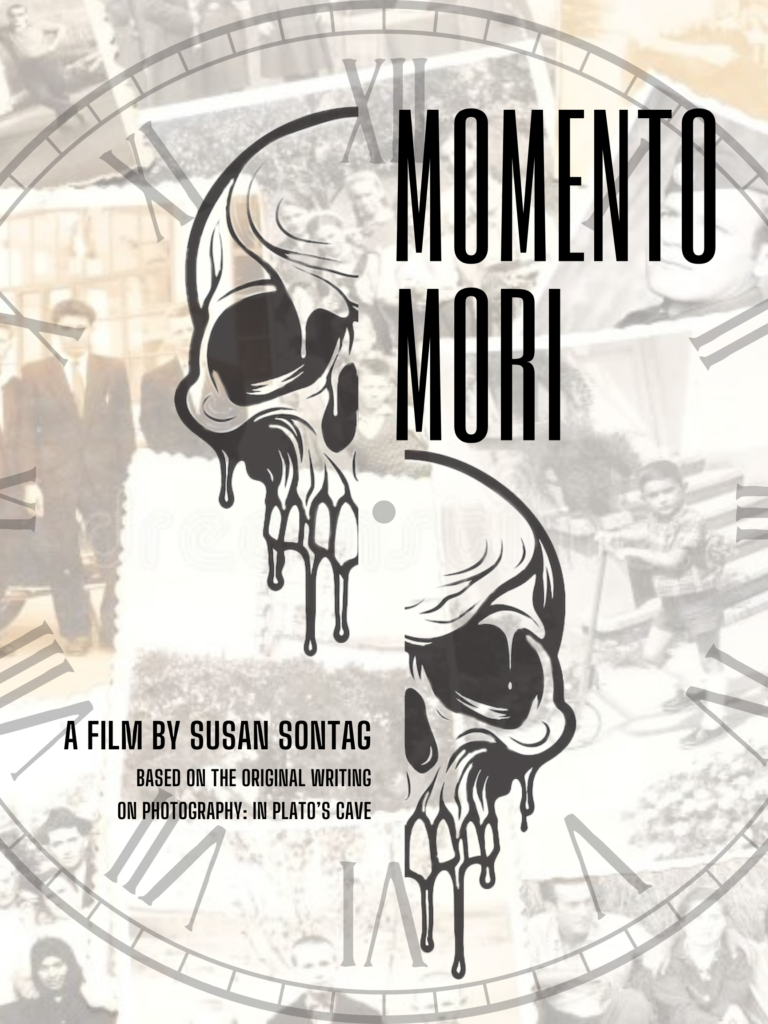
The idea behind this title, Momento Mori, comes from the quote above from Sontag’s “In Plato’s Cave”. This idea stood out to me because of the thought that photographs are “Momento Mori”, which is described as “an object serving as a warning or a sign of death.” Sontag goes on to explain that photographs are used to preserve something, such as a family memory, which inevitably relates to that moment, person, or thing eventually dying and the photograph serving in its memory as a frozen slice of time.
I thought this idea would be an interesting film, so for my movie poster I decided to highlight the phrase Momento Mori, while also capturing the essence of photographs testifying to time’s relentless melt. In order to do this, I chose a background with what could be family photos from an old album, layered with time and death imagery. For the melting skull, I had a specific vision for the imagery because of the title phrase. I wanted the symbol of death to also embody “melting” because I found that choice of wording to be integral to the entire idea of photographs contributing to the certainty of death by preserving a moment in time.
This hypothetical film would be based on “In Plato’s Cave”, as said on the poster, by being thematically centered around the idea of photographs testifying to time and death. This could be an interesting mystery and psychological thriller film, if photographs served as weapons which would contribute to characters fates in life or in death. With this vision in mind, I selected the graphics and font/color choices to produce the idea of mystery and intensity in an abstract way. I wanted the title in collaboration with the visual elements to influence an audience to be intrigued and courious, just as I imagine the characters in this film would feel during their journey to unlock the meaning behind photographs.
TEXT
The Eternal Playback
Pain, like time, is overwhelmingly present in the now, but fades-blessedly- into nothingness. What if pain did not vanish and we could capture it for eternal playback? Four-dimensional storage would be a diabolical and infernal place of Dasein! Irreversibility is both wonderful and hideous.
The Marvelous Clouds
John Durham Peters
Throughout Chapter 6 of The Marvelous Clouds, John Durham Peters describes media in a way that he relates to the human way of seeing, through our own experiences and feelings. He also makes many references towards the roles of space and time as elements within its relationship with media, which he refers to as "The Interconvertibility of Space and Time." He is fascinated with this concept of media unleashing the opportunity to save and reproduce a moment in time, along with the costs that come with that ability. Within this specific passage, he makes the comparison between pain and its relationship with time, to this ability to remain forever thanks to the power that media has granted us. He is commenting on both the beauties and dangers of this power of freezing time, and wonders what will come of it.
Within the same section of this chapter, he inserts a diagram from Winkler that synthesizes the relationship between time and space in transmission and storage from media:
| Overcomes | Consumes | |
|---|---|---|
| Transmission | Space | Time |
| Storage | Time | Space |
This chart explains how transmission allows real-time experiences that overcome physical space but last for just a moment, while storage preserves memories, overcoming the passage of time but potentially trapping us in an endless cycle of past experiences. It allows us to have an understanding of the way we process pain and memory. While transmission connects the moment, the desire to store experiences permanently can lead to a burden that obscures the natural flow of time and healing. The connection between momentary pain and the weight of eternal memory conceptualizes the tension between the joy of living and the potential danger of suffering forever.
John Durham Peters is seemingly worried about the nature of being able to freeze time because of his choice to relate this power to something as impactful as pain as an example. While I agree with his concern, I also believe that this aspect of media can and has been used in ways that capture pain in a way that is inspiring and beautiful. Capturing and prolonging something that induces pain can also be a way to connect with others and understand shared experiences. This thought brought me back to Documentary Research, a course I took a couple of years ago. In this course, we learned about how documentaries are the closest thing we have to capturing true reality. This form of media is the perfect example of capturing pain and reproducing it so that it may live forever. Documentaries have the ability to reproduce pain in a way that is influenced by the documentarian themselves. Their influence, otherwise known as location, contributes to the way we view the pain that is reproduced through their own intentions of the audience’s vision. In this way, I believe that the concept of capturing the eternal playback of pain can be used in a way that enriches society, rather than it being a danger. John Durham Peters, I believe, would also see this to be true, however he would think of it more in terms of physical elements of pain which can be skewed to seem like more of a danger.